
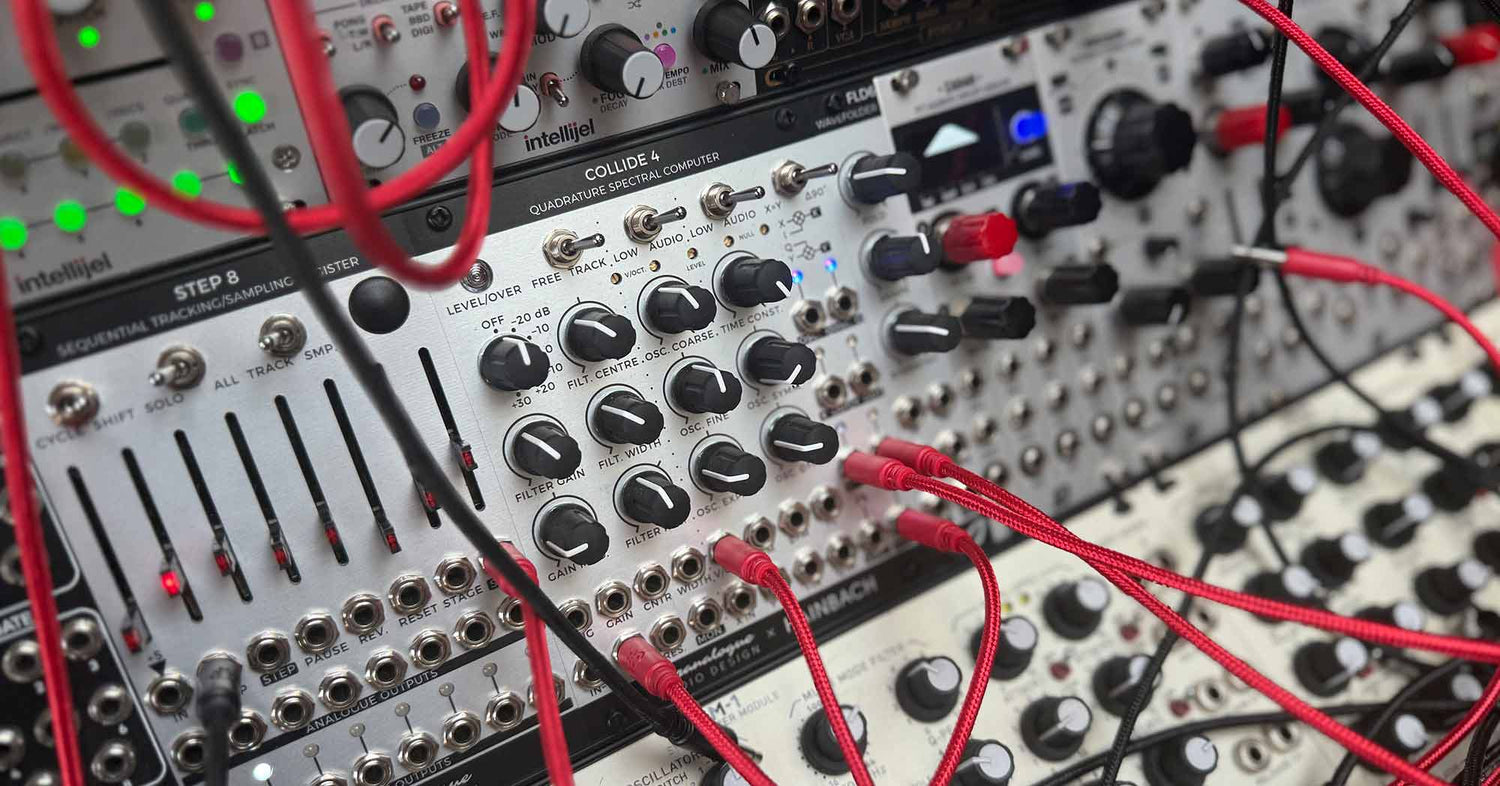
Some modules arrive and you know immediately they're going to reshape how you work. The Joranalogue Collide 4 is one of those.
The Joranalogue Collide 4 is a lock-in amplifier reborn as a Eurorack synthesizer voice. Part physics instrument, part percussion engine, part frequency shifter, part complex oscillator. On paper it sounds intimidating. Patched up and running at three in the morning, it sounds absolutely monstrous.
Table of contents

Where this module came from and why it matters
The lock-in amplifier is a piece of test equipment that was originally designed to detect tiny voltage fluctuations buried inside particle accelerators. Its job is to lock onto a specific frequency inside a wash of noise, filter it out, match its phase, and amplify it with extraordinary precision. It is a piece of cold, clinical scientific infrastructure and it sounds extraordinary.
Electronic music pioneer Hainbach spent years sourcing vintage lock-in amplifiers from defunct nuclear research facilities, recognising that the oscillators and op-amp circuitry inside these instruments shared almost identical DNA with the legendary ARP 2500 synthesiser. The tonal character is something you cannot fake digitally: enormous low-end weight, bell-like ring, and a particular kind of harmonic shimmer that sits right between pure sine waves and controlled distortion.
The Collide 4 is the result of Hainbach collaborating with Joranalogue Audio Design, a Belgian manufacturer whose philosophy is, in their own words, "lab-grade synthesis." The goal was not to dumb down the original instrument for musical use, but to give it full voltage control and bring it into Eurorack at 20HP. What came out is something the manual itself calls a Quadrature Spectral Computer a name that is entirely accurate and entirely unhelpful until you start patching.
The architecture
What you're actually working with
Five sections. They talk to each other constantly, so it helps to know what each one does.
A — The Input Section
Your audio comes in here, gets amplified, and passes through a bandpass filter that can be pushed into self-oscillation — at which point it becomes its own sound source. Control the frequency, width and resonance independently. Drive the gain hard and it distorts in a very musical way. Two gain stages stacked, with enormous headroom.
B — The Oscillator
A sine and cosine wave pair, running 90 degrees apart. It tracks pitch accurately across the full audio range, supports through-zero frequency modulation, and can scan smoothly between positive and negative frequencies on a single knob. More on why that matters shortly.
C — The Detector
Two ring modulators multiply your input signal against the oscillator. Before that happens, the Hilbert network can split your signal into two phase-offset copies — which is what unlocks the frequency shifter behaviour. A pair of lowpass filters follow the ring modulators to shape the final character.
D — The Output Section
Multiple outputs including direct, sum, and difference — but the ones that make this module special are Magnitude and Phase. Both are live voltages generated by the patch itself, constantly moving, constantly useful as modulation sources.
"The Magnitude output is one of the most unique CV sources in all of Eurorack. It's tracking the amplitude envelope of the internal process and giving it back to you as a voltage."
Bass sounds
Where the Collide 4 earns its place in a techno or deep house rig
Let us be direct: this module makes bass sounds that are difficult to achieve any other way. The combination of a self-oscillating filter, a quadrature VCO capable of TZFM, and two ring modulators means that the fundamental frequency content and harmonic structure of your bass can be manipulated simultaneously and in real time.
For techno applications, the subtractive path is the first territory to explore. Set the filter to self-oscillation, run the Collide 4's oscillator at a low frequency, and use the TZFM input driven by your V/Oct sequence. The filter tracks at 1V/octave independently from the oscillator — in track mode they follow together, or in free mode you can push the filter to a fixed low frequency while the oscillator is modulated. The output from the Sum or Difference jack carries that particular locked-in character: a fundamental with tightly controlled harmonics that respond to the oscillator's frequency relationship with the input.
For deep melodic techno and deep house contexts, the frequency shifter configuration opens up tonal space that is almost impossible to describe concisely. Feed a simple bass sine wave into the input, engage the Hilbert network, dial the oscillator to a very small shift — a few hertz — and the output develops a subtle inharmonic spreading that makes a mono bass sound three-dimensional and constantly alive. This is not chorus or flanger. It is a mathematically different process, and it sits in a mix completely differently. Push the shift amount further and the bass becomes something more abstract — perfect for Afro organic house contexts where you want percussion and harmony to blur together.
Afro organic house and the texture dimension
The genres we work in at Audiotent are not just about technical precision — they are about feel. The organic warmth of Afro house, the breath and movement of deep melodics, the controlled intensity of techno: all of these require sounds that breathe, evolve, and carry emotional weight. The Collide 4 excels here because its outputs are never static. The Phase output, fed back into the TZFM input, creates evolving modulation structures that are self-generating. The Magnitude output, used to modulate filter gain or oscillator frequency, creates envelope-following behaviour without a dedicated envelope generator. These are living, breathing signals.

Percussion synthesis
Pinging the filter and building drums
One of the most immediately accessible and sonically powerful features of the Collide 4 is its Ping input. A trigger or gate signal above +3V strikes the variable bandwidth filter like a mallet on a resonant body. The pitch is set by the filter's centre frequency. The decay and ringing are controlled by the resonance and width parameters. The amplitude is shaped by the pre-amp and output gain settings.
This is not a watered-down drum voice. At low centre frequencies with high resonance and narrow width, you get the kind of sub-bass kick weight that can genuinely move air in a club. Tighten the width and the attack sharpens. Open the width and the transient blooms into something more tom-like or bongo-esque. Push the filter gain into clipping and the ping response becomes a hard-edged, distorted thump. Dial it back to unity and you get clear, bell-like sine decay.
The percussion synthesis patch described in the manual, patching the Magnitude output back into the TZFM input with maximum negative modulation, creates a pitch drop that sweeps the oscillator through its frequency range in exact response to the ping's amplitude. This is how you make a bass drum that has real pitch movement, not a fake envelope-controlled pitch automation, but actual through-zero frequency traversal driven by the energy of the hit. It sounds enormous.
Patch Recipes 👨🏻🍳 🎛️
|
Patch Recipe Club-ready kick drum No external modules required. → Trigger into Ping input
→ Filter centre at 9 o'clock, resonance near self-oscillation
→ Magnitude output → TZFM input, knob full negative
→ Oscillator symmetry at maximum, both frequencies at 9 o'clock
→ Listen at X'−Y' or X'+Y' output
|
Patch Recipe Self-generating bass loop For deep melodic and minimal techno. → Filter in free mode, self-oscillating, gain at unity
→ Monitor output → oscillator Exp FM input
→ Oscillator in track mode, V/Oct from sequencer
→ Phase output → filter centre CV for harmonic drift
→ Time Constant at mid-range for texture control
|
|
Patch Recipe Organic percussive texture Pairs with external sound source. → External rhythmic source into differential input
→ Hilbert switch to Δ90°
→ Oscillator at near-zero frequency (Symmetry centred)
→ Scan the Symmetry knob slowly for evolving shifts
→ Use both Sum and Difference outputs as stereo pair
|
Patch Recipe Afro house melodic texture Frequency-shifted harmonic source. → Melodic input (marimba, kora, or pluck synth) into preamp
→ Hilbert switch to Δ90°, oscillator at 5–15 Hz
→ Sum and Difference outputs as stereo pair into reverb
→ Modulate oscillator frequency with slow LFO for drift
→ Use Magnitude output to automate reverb send level
|
The Collide 4 and Step 8
The pairing that changes everything

No module exists in isolation in a Eurorack system, but some combinations feel as though they were designed specifically for each other. The Joranalogue Step 8 a Sequential Tracking/Sampling Register is that module for the Collide 4. Calling the Step 8 a sequencer undersells it profoundly. It is an analogue 1-to-8 signal switch feeding eight independent track/sample-and-hold stages, each with its own attenuated output and gate signal. It can function as a sequencer, an analogue shift register, a clock divider, a voltage mapper, or a rotating memory loop and it can be switched between these behaviours dynamically.
What makes the Step 8 so powerful alongside the Collide 4 is the quality and variety of CV it can produce. Each of the eight stages holds a voltage with extremely low droop pitch-accurate for minutes meaning you can store precise frequency values and recall them in sequence. Feed one of the Step 8's scanning output into the Collide 4's V/Oct oscillator input and you have a melodic sequencer. Feed a different stage output into the filter centre CV and you have an independent harmonic sequence running simultaneously. Feed gate outputs from various stages into the Collide 4's Ping input and you have rhythmic percussion events timed to specific steps in the voltage sequence.
In shift register mode, the Step 8 takes a single input voltage and passes it from stage to stage on each clock tick. Each stage holding the previous stage's value as the new one arrives. Patching the Magnitude output of the Collide 4 into the Step 8's signal input in shift mode creates a moving memory of the Collide 4's amplitude envelope over the last eight steps. This voltage pattern, fed back into the Collide 4's TZFM or filter CV inputs, generates organic modulation sequences that reference the patch's own history. It is generative synthesis at its most elegant.
Key Patch — Step 8 + Collide 4
Rotating voltage loop for endless evolving sequences
Set Step 8 to sampling shift mode. Connect the Collide 4's Phase output to the Step 8 signal input. Connect the Step 8 scan output to the Collide 4's filter centre CV. Connect Step 8's final stage analogue output back to its own signal input (creating the rotating loop). Clock both modules from the same source. As the Phase output of the Collide 4 evolves, it writes new values into the rotating register — values that immediately start feeding back into the filter to alter the next phase reading. The result is a self-modifying loop that never exactly repeats.
The Step 8's per-stage gate outputs are equally valuable. In a techno context, programme a kick on step 1 (triggering the Collide 4's Ping), melodic filter pings on steps 3 and 7, and use the Step 8's pause input (driven by a comparator or logic module) to drop out of sequence mid-phrase. The Step 8 can also run its stage input from an analogue CV, effectively addressing any of its eight stored voltages directly which means you can use the Collide 4's Magnitude or Phase outputs to scan through the Step 8's stored values dynamically, creating pressure-sensitive or amplitude-responsive sequence navigation.
Together, these two modules 36 HP of Belgium-built analogue precision cover more sonic and compositional territory than systems four times their combined size.
How we use the Collide 4 to build our sample libraries
At Audiotent, the Collide 4 has become a cornerstone of our hardware sample production workflow for good reason: it generates sounds that exist nowhere else, and it generates them in categories that translate directly into usable production material.
For one-shot percussion, the Ping input workflow is fast and endlessly variable. A single trigger source into the Ping, with the Step 8 providing different stored voltages to the filter centre CV on each consecutive take, gives you a family of tonally related percussion hits, same character, different pitches. We capture these across three to four octaves, giving producers an instrument rather than just a sample. The distortion character of the filter gain VCA adds punch that sits perfectly in dense techno arrangements without needing additional saturation.
For bass loops, we typically run the Collide 4 as a complex oscillator self-oscillating filter as modulator, quadrature VCO as carrier sequenced by the Step 8 over eight steps. We then take multiple passes, adjusting the Time Constant filter, the oscillator's TZFM depth, or the Hilbert switch state between recordings. The resulting loops have genuine phrase-level evolution: they are not a single timbre looping, but a living process that moves through harmonic space.
For textural and atmospheric one-shots, the frequency shifter configuration with a short burst of audio through the input captures moments of extreme harmonic complexity the kind of transitional texture that works as a riser, a hit, or a background atmosphere in Afro organic house and deep melodic contexts. A vocal fragment, a struck bowl, a piano chord run through the Collide 4 with the oscillator scanning through frequencies via the Symmetry knob produces something genuinely alien that still carries the DNA of the original source.
Is the Collide 4 right for you?
The manual describes it as being on the "Dark Souls side of synthesis" and Hainbach is not wrong. There is a learning curve. The relationship between the input section, oscillator, Hilbert switch, balanced modulators, time constant, and output section is not immediately obvious, and the interaction between all of these under CV control takes time to develop intuition for.
But if you work in the genres we work in at Audiotent, if you want bass that has real weight and harmonic complexity, percussion that feels like it was struck rather than programmed, textures that move organically rather than mechanically, then the Collide 4 will repay every hour you put into understanding it. It is not an easy module. It is a deep one. And in our experience, deep is always worth it.
Pair it with the Step 8 and you have a generative, evolving synthesis system that can produce material for years without feeling exhausted. This combination sits permanently in our production rack. It has earned that place. 😎


Leave a comment
This site is protected by hCaptcha and the hCaptcha Privacy Policy and Terms of Service apply.